Lubes em Foco Magazine – issue 98
Click on the magazine and read, download, or share the articles:
by: Sérgio Rebêlo , Director of FactorK
The Paradox of Success in the Brazilian Lubricants Market
The Brazilian lubricants market presents a remarkable paradox. On one hand, it represents a global success story: an oasis of resilience and growth in an international environment marked by stagnation. While developed markets face sluggish growth projected at around 1% per year, Brazil, driven by its unique energy matrix based on the flex-fuel hybrid model and a robust internal combustion engine ecosystem, is expected to achieve growth of approximately 2% per year over the next decade. Although modest in absolute terms, this performance is significant for a mature and consolidated industry.
However, for leading companies, this success brings a formidable strategic challenge. In a highly competitive environment, with more than 200 brands competing for consumer preference, the pursuit of growth through market share gains has become a high-cost, low-return battle. Every percentage point of market share is won through massive investments in marketing, subsidies to distribution channels, and relentless pressure on profit margins.
The question facing executive leadership is therefore unavoidable: if the traditional volume-growth lever is becoming increasingly expensive and delivering low returns on invested capital, how can companies continue to create meaningful and sustainable value for shareholders?
The answer lies in a fundamental shift in mindset: from an obsession with volume growth to a disciplined and strategic pursuit of value growth. This requires exploring new strategic dimensions capable of expanding profitability, resilience, and the long-term potential of the business, often independently of simply increasing the number of liters sold in the domestic market.

This article explores five alternative strategic pathways for value creation, specifically designed for leaders in the Brazilian lubricants market. These are routes that require courage, long-term vision, and a willingness to challenge the industry’s established dogmas.
Path 1: Internationalization as a Driver of Value Creation
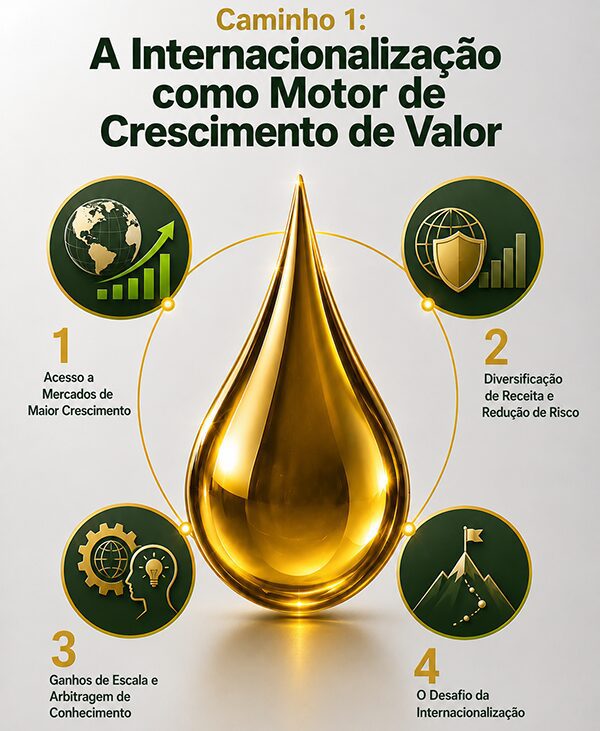 The first frontier for value creation lies beyond national borders. When properly executed, internationalization creates value through multiple complementary mechanisms.
Access to Higher-Growth Markets
Latin America, Africa, and parts of Asia still offer lubricants markets growing faster than Brazil, providing an avenue for volume expansion that is less costly than competing for market share in the domestic market. While Brazil is expected to grow at approximately 2–2.5% annually, selected emerging markets are expanding at 4–6% per year, often with lower levels of consolidation
Revenue Diversification and Risk Reduction
Dependence on a single market—even one as large as Brazil—represents a significant strategic risk. A presence across multiple geographies reduces exposure to currency fluctuations, political uncertainty, and market-specific risks, making the company more resilient and more attractive to institutional investors.
Economies of Scale and Knowledge Arbitrage
A global operation enables companies to optimize raw-material procurement, manufacturing, and logistics, generating economies of scale. Additionally, it enables “knowledge arbitrage,” allowing lessons learned in one market to be applied in others while spreading R&D costs by adapting innovations across multiple territories.
The Challenge of Internationalization
Internationalization is not a trivial undertaking. It requires a deep understanding of the cultural, regulatory, and competitive nuances of each new market, as well as a governance model capable of balancing centralized control with local agility. Success requires exporting a winning business model while intelligently adapting it to each new market reality.
Path 2: Moving Up the Value Chain (Growth Through High Value-Added Segments)
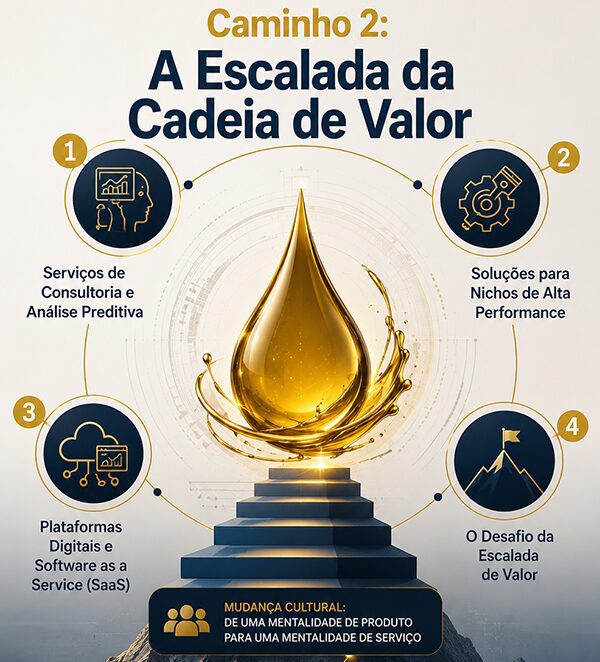 If horizontal growth (volume) is becoming increasingly expensive, vertical growth (margin expansion) is the smarter alternative. This means shifting the company’s focus from simply selling liters of lubricant to providing complete solutions and high value-added services, transforming customer relationships from transactional interactions into strategic partnerships.
Consulting Services and Predictive Analytics
Offering oil analysis, condition monitoring, and predictive maintenance consulting creates new revenue streams with high margins (40–50%) while establishing strong customer retention barriers. Customers increasingly view the company as a strategic partner in their pursuit of operational efficiency.
Solutions for High-Performance Niches
Developing and dominating segments where lubricant performance is critical and price is a secondary consideration (such as food-grade lubricants, wind turbines, mining, and high-performance steelmaking applications, among others). Technical expertise in these niches justifies significant price premiums and creates sustainable competitive advantages.
Digital Platforms and Software as a Service (SaaS)
Building digital platforms that help customers manage lubrication programs and optimize maintenance activities can become a recurring, predictable, and highly profitable source of revenue with attractive returns on invested capital.
The Challenge of Moving Up the Value Chain
This strategy requires a profound cultural transformation—from a product-oriented mindset to a service-oriented one. It demands investment in talent (engineers, consultants, and software developers) as well as an organizational structure capable of supporting the sale of complex solutions through a consultative, results-driven approach.
Path 3: Mastering the Value Chain (Strategic Vertical Integration)
Vertical integration, whether upstream (raw materials) or downstream (distribution), is a classic strategy for increasing control and capturing a greater share of value.
Forward Vertical Integration: Controlling Market Access
 Acquiring or building distribution networks and specialized retail operations (such as oil change centers) captures intermediary margins, secures exclusive sales channels, and provides direct access to valuable consumer data. Expanding into integrated automotive services (filters, tires, diagnostics, and related services) can transform the point of sale into a convenience hub, increasing average transaction value and customer loyalty
The Challenge:
This is a capital-intensive initiative with significant managerial complexity. It requires expertise in retail operations and last-mile logistics—capabilities that differ substantially from the core competencies of a lubricant manufacturer.
Backward Vertical Integration: Supply Security and Cost Control
In a world of increasingly volatile supply chains, securing access to critical raw materials is a decisive competitive advantage. Investing in rerefining facilities, distribution infrastructure, and/or base oil production provides greater control over costs and supply reliability. Integration with, or strategic partnerships involving, additive manufacturers—while complex—can secure access to the technology that lies at the heart of lubricant performance.
The Challenge:
Backward integration is highly capital-intensive and requires deep technical and market expertise. The risk of allocating capital to assets that generate lower returns than the core business is significant. Joint ventures with established industry players may offer a more prudent and balanced approach.
Path 4: M&A as a Strategic Accelerator
 Mergers and acquisitions are not a strategy in themselves, but rather a powerful accelerator of other value-creation pathways.
Consolidation Among Major Players
The pursuit of cost synergies, portfolio optimization, and economies of scale can justify major consolidation moves among industry leaders. However, integration complexity and regulatory approval remain significant challenges.
Acquiring Niche Players: The Smartest Use of M&A
Acquiring smaller companies that already lead high-value segments (specialty industrial lubricants, biolubricants, oil analysis services, and similar businesses) allows large players to buy rather than build new capabilities and access to high-margin markets. This is often a faster and less risky route than internal development.
Strategic Alliances and Joint Ventures
When entering highly complex business areas, a partnership with a technology player may be more effective than a direct acquisition, enabling both parties to share risks and investment requirements.
The Challenge:
Success in M&A depends on a clear investment thesis, rigorous due diligence, and, most importantly, the integration capability required to capture the promised synergies without destroying the value of the acquired company.
Path 5: The Smart and Lean Player (The Asset-Light Model)
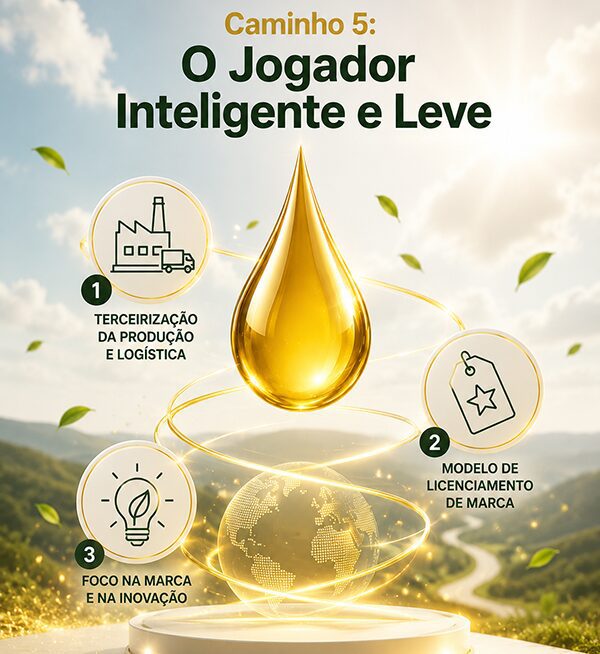 In contrast to vertical integration, the asset-light model seeks to create value by minimizing fixed assets and invested capital while maximizing agility and return on invested capital (ROIC).
Outsourcing Production and Logistics
Leveraging the excess capacity of strategic partners—such as blenders, contract manufacturers, and logistics providers—frees capital that can be invested in higher-return activities such as R&D, marketing, and brand building.
Brand Licensing Model
In smaller or higher-risk international markets, licensing the brand and technology to a local partner generates high-margin, low-risk royalty income.
Focus on Brand and Innovation
The essence of the model is to concentrate 100% of resources on the activities that truly create differentiation: brand strength, research and development, and strategic channel management. Everything else can potentially be outsourced.
The Challenge:
Success depends on exceptional partner-management capabilities, an extremely strong brand, and an unwavering focus on intellectual property protection and quality assurance.
Strategy Matrix: Smart Combinations
The most successful companies do not choose only one of these strategies. Instead, they combine multiple pathways, creating a strategic portfolio that maximizes value creation.

Conclusion: Choosing the Future
The Brazilian lubricants market no longer offers the luxury of easy growth. Creating value for shareholders will require far more than simply pursuing volume expansion. It will demand a conscious and disciplined strategic choice among these five pathways—or, more likely, an intelligent and well-orchestrated combination of several of them.
There is no single right answer. The optimal strategy for each market leader will depend on its culture, assets, risk tolerance, and execution capabilities. The only truly unacceptable choice is inertia. Continuing to fight the same battle for market share, with the same weapons, on a field of diminishing returns, is a recipe for stagnation.
The future belongs to those who have the courage to challenge the dogma of growth at any cost and the vision to build a business model that is not only larger, but fundamentally more valuable, more resilient, and better prepared for the challenges of the twenty-first century..
About FactorK
FactorK is a strategic consulting firm specialized in helping companies in the energy and lubricants sectors navigate their most complex challenges and develop strategies that create sustainable long-term value. Combining deep market expertise with a rigorous data-driven approach, we work side by side with our clients to design and implement transformational strategies.