Lubes em Foco Magazine – issue 98
Click on the magazine and read, download, or share the articles:
By: Isabela Magri, Especialista de Aplicação
Jorge Perrotta, Engenheiro de Aplicação
The presence of water in lubricating oils compromises the performance and lifespan of mechanical and hydraulic systems. Water accelerates oil oxidation, promotes corrosion of metal surfaces, alters viscosity, and contributes to the depletion of additives and the formation of sludge. In hydraulic oils and transmission fluids, water is also associated with component wear. Therefore, controlling the water content is a central parameter in quality control, in the analysis of oils in use, and in predictive maintenance programs.
The Karl Fischer titration is the established reference method for quantifying water. It is recognized for its sensitivity at low levels and remains widely used. In parallel, instrumental evolution has brought a physical alternative: the determination of water by relative humidity sensor. The method eliminates the need for chemical reagents, generates less waste, and delivers results in a few minutes, characteristics aligned with modern laboratories and sustainability goals.
Principle of the relative humidity sensor method
The method is physical and is based on the controlled vaporization of water. The sample is contained in a vial with a septum and heated in an oven at adjustable temperatures from 25 °C to 300 °C. Heating releases the volatiles present in the sample. A dry carrier gas transports these volatiles from the vial to the sensor block.
The block contains a polymer capacitor-type relative humidity sensor. The sensor responds specifically to water. The measurement is not a direct reading from the sensor. The result integrates three variables, processed by a microprocessor: the signal from the relative humidity sensor, the temperature of the sensor block, and the flow of the carrier gas. It is this combination of parameters, and not the isolated reading from the sensor, that allows the determination of the water content in matrices of varying composition. The specificity of the method stems exclusively from the sensor’s response to water, and not from the nature of the transported volatiles.
Before analysis, a purging step removes residual moisture from the vial. An apparently dry vial retains microscopic droplets of water on its walls and traps ambient moisture when closed. Tests indicate that, under normal conditions, this contribution varies from 200 to 400 µg, depending on the ambient humidity. A purge of 30 to 45 seconds reduces this contribution before measuring the water content of the sample.
Karl Fischer Method
The Karl Fischer titrator is the dedicated instrument used for this water determination technique, which is widely standardized and recognized for its high sensitivity at low moisture levels. The Karl Fischer titration system promotes a stoichiometric chemical reaction between water, iodine, sulfur dioxide, and a base in an alcoholic medium. The instrument dispenses the reagent until the reaction endpoint is reached, and the result is calculated from the amount of reagent consumed, which is directly proportional to the water content present in the sample.
Difference compared to the relative humidity sensor method
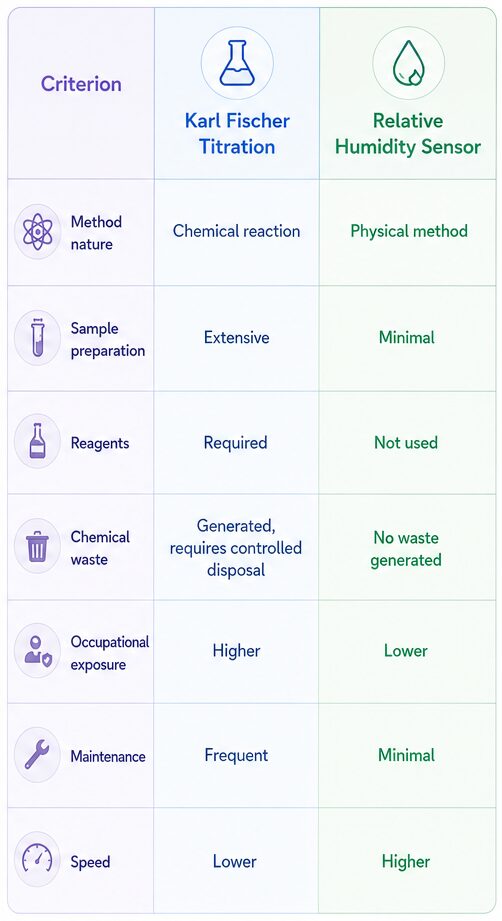
The relative humidity sensor method does not promote a chemical reaction with the sample. The determination is exclusively physical, based on vaporized water detected by the sensor. This difference has practical consequences. The physical method eliminates reagent preparation, frequent standardizations, and the disposal of chemical waste. It also reduces the risk of error associated with reagent contamination by atmospheric humidity.
Selectivity and interfering factors
Karl Fischer titration can be affected by interference from compounds that react with the titrating reagent, such as ketones, aldehydes, and amines. In oils with certain additives, this requires method adaptations. The relative humidity sensor method does not depend on chemical reaction and is less susceptible to this type of interference.
The physical method, however, has its own interferents. Ammonium hydroxide, ethanol, methanol, and acetone are incompatible with the sensor and should not be included in the sample. In lubricating oils, these substances are rare, which favors the application of the method in this class of products.
Operational and environmental advantages
The absence of reagents simplifies the operation and reduces the need for specialized training. The method eliminates the handling and disposal of alcoholic solvents, iodine, and sulfur dioxide. This reduces occupational exposure and the generation of hazardous waste. Maintenance is less: unlike Karl Fischer titration, which requires periodic cleaning of electrodes and replacement of reagents, the physical method has no electrodes or reagents to replace. Calibration uses capillary tubes traceable to NIST and is verified in a few minutes.
Speed is a significant advantage in routine use. The analysis time varies according to the matrix and the temperature applied, generally from a few minutes to about 16 minutes. In high-volume laboratories, this represents a gain in productivity.
Performance and correlation with Karl Fischer titration
There are instruments based on this technology available on the market capable of detecting water contents as low as 10 ppm, with a resolution of 1 ppm and an accuracy of ±5% at 1000 µg of released water. Repeatability, expressed by the coefficient of variation, is typically less than 10% for contents above 0.1% and less than 15% for contents below 0.1%.
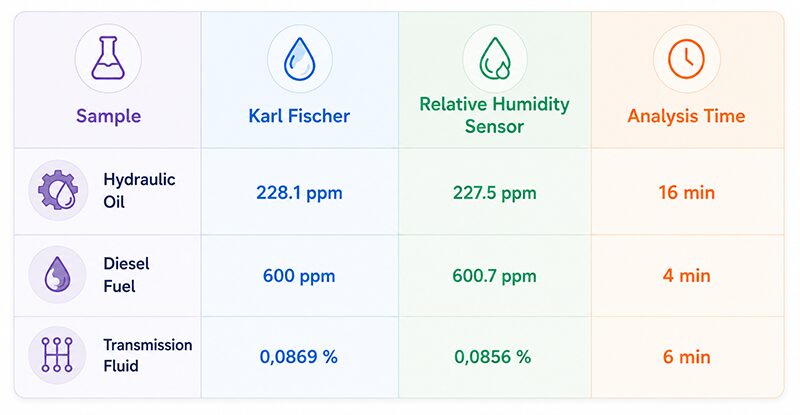
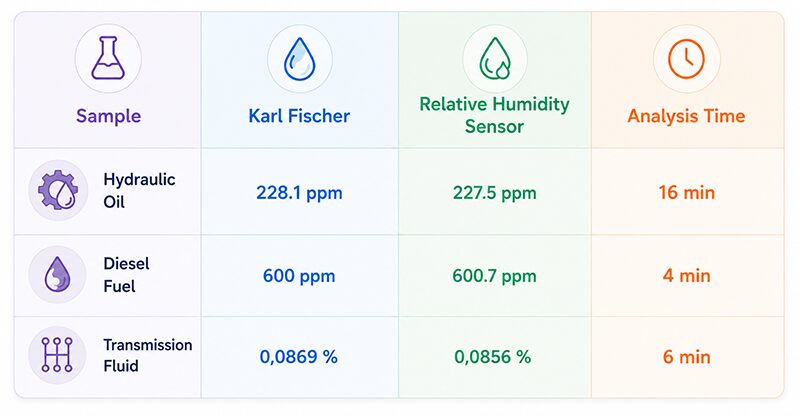
The following results compare the average values obtained by the two methods in three matrices, as an example. The analyses by relative humidity sensor were performed on a Computrac® Vapor Pro® XL analyzer (AMETEK Brookfield). The analysis times refer to the relative humidity sensor method.
The relative difference between the methods was below 2% in the three matrices: 0.3% in hydraulic oil, 0.1% in diesel oil and 1.5% in transmission fluid. This is a point-by-point comparison, of an illustrative nature, and not a validation study. The analytical equivalence between the physical method and the Karl Fischer titration is established by the ASTM D7546 standard and the documented correlation with ASTM D6304. The capacitive sensor detects small variations in relative humidity in the carrier gas, which provides good repeatability and reduces the variability associated with the manual preparation of reagents.
Comparison between the methods
 Normalization
 The relative humidity sensor method applies to new and used lubricating oils and additives according to ASTM D7546, which describes the determination of moisture in these products using a relative humidity sensor. The same principle extends to other petroleum fluids. The results correlate with the industry-standard Karl Fischer titration method, ASTM D6304, applicable to petroleum products, lubricating oils, and additives by coulometric titration. This correlation supports the adoption of the physical method in quality control and predictive maintenance routines.
Conclusion
Water control in lubricating oils can be conducted using different techniques. Karl Fischer titration is widely used, and the relative humidity sensor method has been adopted by laboratories in Brazil and worldwide for the analysis of water in new and used lubricating oils, providing fast and reproducible results that correlate with standardized reference methods. Because it eliminates the need for reagents and generates no chemical waste, this physical method directly addresses the sustainability goals of laboratories. In this context, it establishes itself as a modern, clean, and productive option, aligned with the future of analysis in the lubricants sector.