Lubes em Foco Magazine – issue 98
Click on the magazine and read, download, or share the articles:
By: Leticia Lazaro
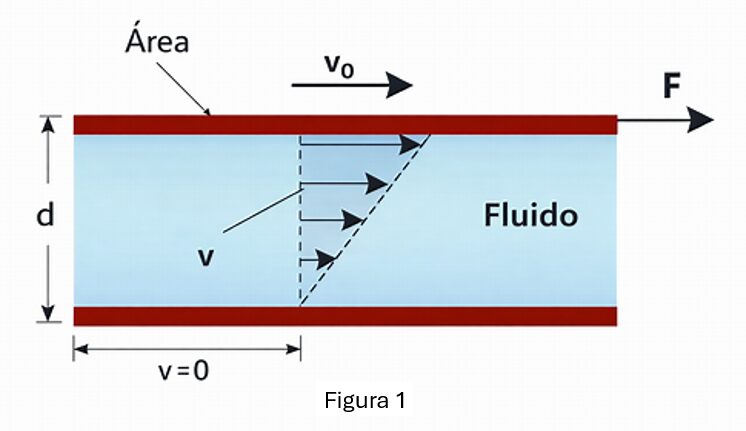
Rheology studies properties such as viscosity, plasticity, elasticity, and the flow of matter. For flow to occur, a force in the direction of flow is necessary. This force divided by the area over which this force is applied is called shear stress.
In Figure 1, we identify shear stress as the force F divided by the area. In the case of liquids, they do not resist the application of this force and deform rapidly, flowing. This flow is related to the viscosity of the fluid, which is its internal resistance to flow. The higher the viscosity, the greater the shear stress required for flow to occur. In Newtonian fluids, such as lubricating oils in general, this stress is proportional to the deformation (shear rate).
In addition to Newtonian fluids, there are other rheological classifications (Figure 2) such as:
- Bingham plastic – require an initial shear stress to begin flowing. When they reach this stress, they behave like a Newtonian fluid (example: gel-based cosmetics)
- Pseudoplastic fluid – as shear stress increases, viscosity decreases and the fluid flows more easily (example: ketchup)
- Dilatant fluid – as shear stress increases, viscosity increases and the fluid has more difficulty flowing (example: cornstarch with water)
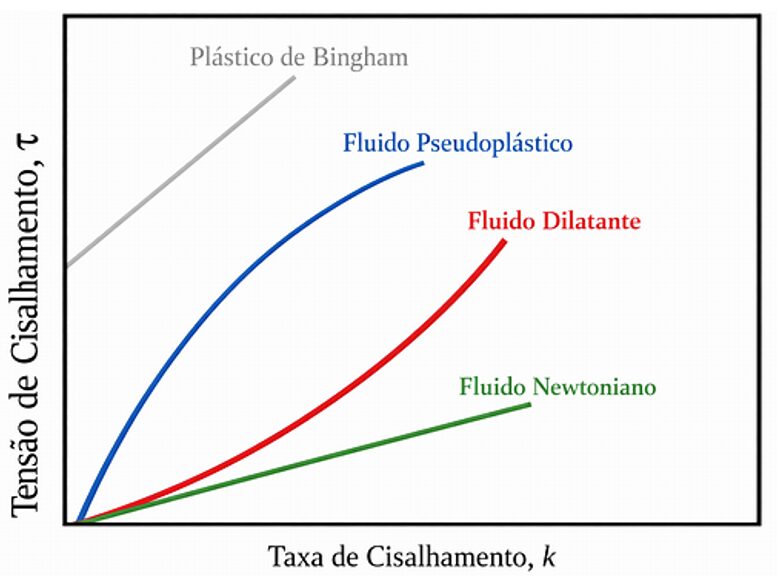
Lubricating oils exhibit Newtonian behavior at usual application temperatures. However, at low temperatures and/or with the use of Viscosity Index Improvers (polymer-based additives), it is necessary to use other methods to evaluate the flow of these oils because they no longer behave as Newtonian fluids.
Brookfield viscosity (ASTM D2983 or ABNT NBR 14541) and CCS (cold cranking system – ASTM D 5293 or ABNT NBR 14173) are tests adopted to better predict the performance of these oils in combustion engines at lower temperatures. These two properties are measured in rheometers and under conditions in which the oil does not behave as a Newtonian fluid. For this reason, these viscosities are called apparent viscosity because it varies with the test conditions, especially with shear stress. It’s important to remember that Newtonian fluids exhibit constant viscosity with variations in shear stress.
Greases are not Newtonian fluids.
Greases are a mixture of lubricating oils with thickeners and do not behave like Newtonian fluids under any conditions. They behave like a pseudoplastic fluid that requires a minimum shear stress to flow. This means that if the stress is less than the minimum stress required for flow, the grease behaves like a solid and does not flow. When the stress exceeds this minimum stress, the grease flows, and as the stress increases, it flows more easily (viscosity or resistance to flow decreases).
The study of this behavior through rheology provides more information about how the grease works, for example in a bearing, than worked penetration, a more common test to characterize the consistency of greases.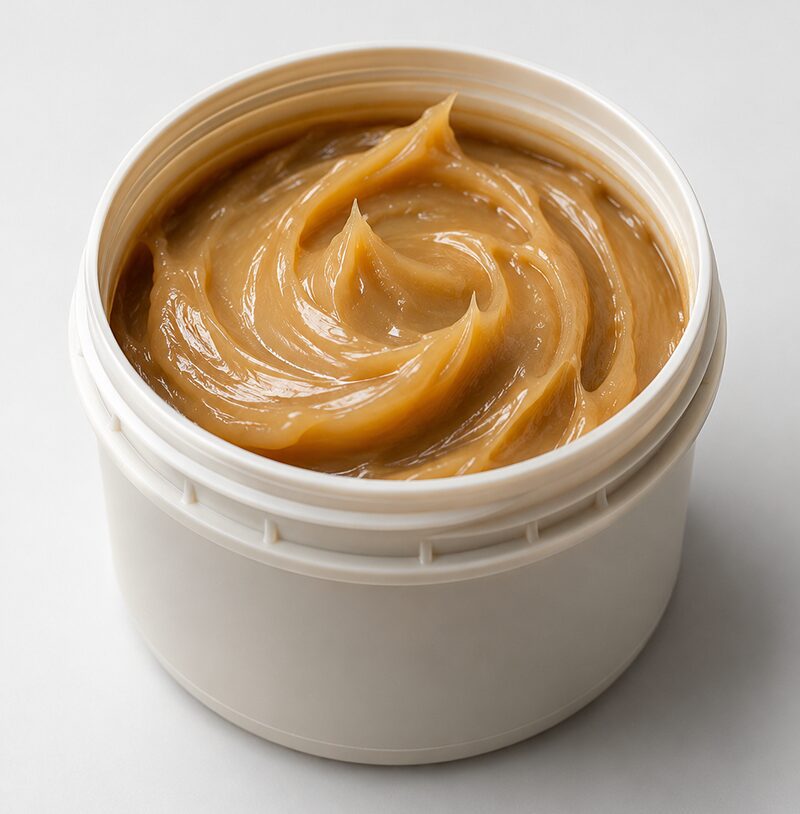
Another property that can be evaluated through rheology is the ability of the grease to recompose its original structure when the stress that makes it flow ceases, for example, when the bearing stops rotating. This recovery capacity is fundamental for the grease to adequately lubricate the equipment.
Overworked penetration helps to identify the resistance of the grease structure to work. It differentiates how well products withstand the work or not, in a more qualitative way. Rheology can determine the boundary conditions under which a given grease recovers its initial structure or not.
The rheology of greases as a tool
The growing importance of this topic is evident in the existence of standards that describe the methodology for measuring these properties, thus standardizing them. The ISO (International Organization for Standardization) published two standards related to the rheology of lubricating greases in 2025. One of them establishes a correlation between rheological properties and the consistency of a grease.
Grease rheology is still a tool that is being increasingly adopted in the research environment, but it is very promising for future adoption as a specification limit, for example.
In future articles, this topic will be explored in greater depth, defining the most important rheological properties, how they are measured, the types of rheometers used, etc.
Follow the next editions of Lubes em Foco magazine to better understand grease rheology. Until then!