Lubes em Foco Magazine – issue 98
Click on the magazine and read, download, or share the articles:
| Page | Article |
|---|---|
| 4 |
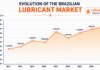
Beyond Volume The Brazilian lubricants market presents a remarkable paradox. On one hand, it represents a global success story: an oasis of resilience and growth in an international environment marked by stagnation. While developed markets face sluggish growth projected at around 1% per year, Brazil, driven by its unique energy matrix based on the flex-fuel hybrid model and a robust internal combustion engine ecosystem, is expected to achieve growth of approximately 2% per year over the next decade. Although modest in absolute terms, this performance is significant for a mature and consolidated industry. |
| 10 |
Minimizing H2ICE pre-ignition As the efforts to reach net zero emissions intensify, the appeal of using alternative low and zero carbon fuels in internal combustion engines (ICEs) is growing. Hydrogen is an attractive option for larger applications, although it comes with a new set of challenges, with pre-ignition being the primary concern for OEMs. Carina Foster, Infineum Commercial Vehicles New Specifications Technologist, talks to Insight about recent lubricant development work that is helping to minimise the number of pre-ignition events in ICEs running on hydrogen. |
| 18 |
Rheology of Lubricating Greases Rheology studies properties such as viscosity, plasticity, elasticity, and the flow of matter. For flow to occur, a force in the direction of flow is necessary. This force divided by the area over which this force is applied is called shear stress. |
| 22 |
Water Analysis in Lubricating Oils The presence of water in lubricating oils compromises the performance and lifespan of mechanical and hydraulic systems. Water accelerates oil oxidation, promotes corrosion of metal surfaces, alters viscosity, and contributes to the depletion of additives and the formation of sludge. In hydraulic oils and transmission fluids, water is also associated with component wear. Therefore, controlling the water content is a central parameter in quality control, in the analysis of oils in use, and in predictive maintenance programs. |